

Search is changing.
People are no longer relying only on traditional search results to discover businesses, compare services, research products, or find answers. AI-powered experiences such as Google AI Overviews, Google AI Mode, and ChatGPT Search are changing how information is discovered, summarized, and presented.
That creates a new visibility challenge for businesses operating in Italy.
When someone asks an AI-powered search engine about your industry, service, product, or company, is your brand part of the answer?
Generative Engine Optimization (GEO) in Italy focuses on improving how your brand, website, expertise, and content can be discovered and understood across AI-powered search experiences.
The goal is not to replace SEO. It is to extend your search strategy so your business can remain visible as search becomes increasingly conversational and generative.
What Is Generative Engine Optimization?
Generative Engine Optimization, commonly called GEO, is the process of improving digital content and brand signals so generative AI systems can better understand, retrieve, summarize, and potentially reference your information.
Traditional SEO focuses heavily on helping webpages appear in search results.
GEO considers another important question:
How can your brand become a useful and trustworthy source when an AI system generates an answer?
AI-powered search can combine information from multiple sources before producing a response. This means businesses need to think beyond traditional keyword rankings and consider the overall quality, structure, relevance, and authority of their online presence.
A strong GEO strategy can involve:
- Clear topical relevance
- Helpful and original content
- Strong entity associations
- Consistent brand information
- Demonstrated expertise
- Relevant external references
- Technically accessible webpages
- Direct answers to customer questions
Why Generative Engine Optimization Italy Matters for Businesses in Italy
For businesses targeting Italian customers, AI search creates another layer of digital visibility.
A potential customer might ask:
- “Qual è il miglior commercialista a Milano?”
- “Which SEO agency in Italy specializes in AI search?”
- “What are the best restaurants in Rome for business meetings?”
- “Which Italian company provides this service?”
- “What should I look for when choosing a lawyer in Milan?”
The response may not look like a traditional list of ten blue links.
Instead, an AI system can synthesize information from multiple sources and provide a concise answer with supporting references.
This makes Generative Engine Optimization Italy increasingly relevant for businesses that depend on organic discovery, local visibility, expertise, or comparison-based searches.
It can be particularly relevant for:
- Local Italian businesses
- Professional service providers
- E-commerce companies
- SaaS businesses
- Hospitality brands
- B2B companies
- Consultants
- Agencies
- Italian startups
- Businesses targeting international customers in Italy
The objective is not to guarantee that an AI system will mention your business.
No legitimate GEO strategy can guarantee a specific AI citation.
Instead, the objective is to strengthen the signals that can make your business easier for search and AI systems to discover, understand, and evaluate.
GEO vs SEO: What Is the Difference?
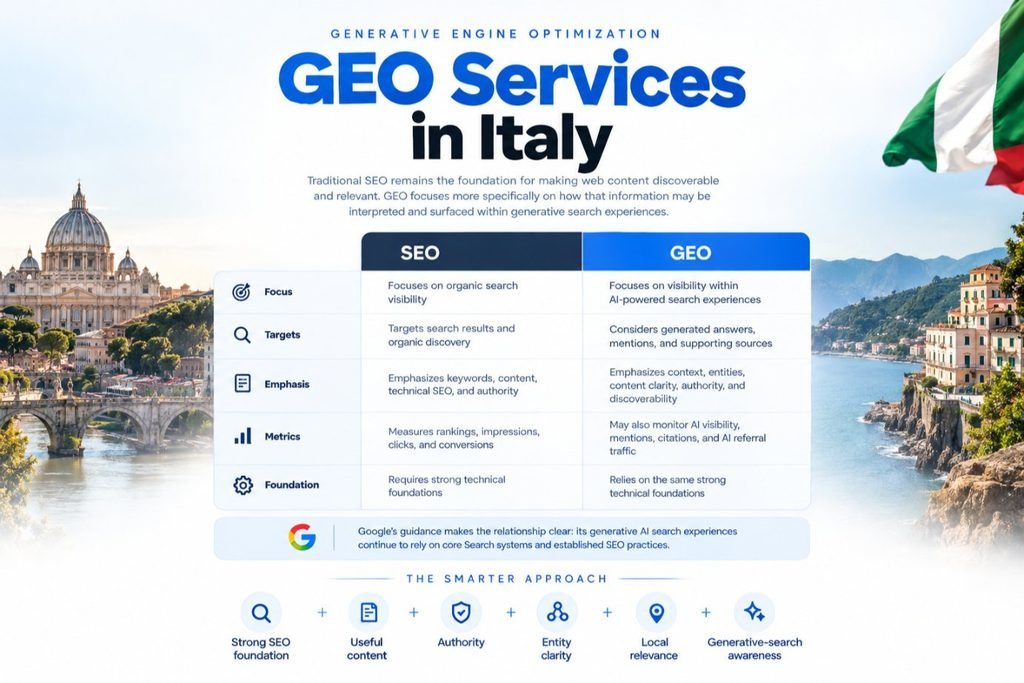
SEO and GEO are closely connected.
SEO helps search engines discover, crawl, understand, and rank webpages.
GEO focuses more specifically on visibility within generative and answer-based search experiences.
The two should not be treated as competing strategies.
| Traditional SEO | Generative Engine Optimization |
| Targets search rankings | Targets AI-generated visibility |
| Focuses on search queries | Focuses on context, entities, authority, and answers |
| Optimizes webpages | Optimizes webpages and broader brand signals |
| Builds organic traffic | Builds opportunities for AI discovery and referral |
| Includes technical and on-page optimization | Builds on SEO with AI-search considerations |
Google has stated that its existing SEO best practices remain relevant for generative AI search features because these experiences continue to rely on Google’s broader search systems.
For a broader look at how SEO, AEO, GEO, AI SEO, and LLM SEO work together, explore How I’d Rank in Google in the AI Era: SEO, AEO, GEO, AI SEO, and LLM SEO Strategy.
How Generative Search Discovers and Uses Content
Generative search does not necessarily behave like a traditional search-results page.
An AI system may interpret a complex question, identify related information needs, retrieve information from different sources, and then construct a response.
This means a webpage can contribute value even when it does not simply rank for one exact keyword.
For example, an Italian company offering accounting services might publish useful content covering:
- Italian tax requirements
- VAT questions
- Business registration
- Accounting terminology
- Industry-specific compliance
- Local service information
- Frequently asked customer questions
Together, these pages create a stronger topical and entity footprint.
The more clearly your content communicates what your business does and what topics it understands, the easier it can become for search systems to interpret your relevance.
If you want to learn more about SEO services and strategies specifically for the Italian market, explore Best SEO Expert in Italy – Grow Your Business with Smart SEO.
How to Get Cited by AI: A 10-Step GEO Framework
There is no guaranteed formula for earning AI citations.
However, a practical Generative Engine Optimization Italy strategy can focus on the following areas.
1. Start With Search Intent
Identify what your target audience actually wants to know.
Do not build your content strategy around keywords alone.
Study:
- Informational searches
- Commercial investigation
- Transactional searches
- Local searches
- Comparison searches
- Problem-solving questions
- Conversational queries
Your content should answer the underlying need behind the query.
2. Answer Important Questions Clearly
AI systems need understandable information.
Start important pages with a concise answer before expanding into deeper explanations.
Use:
- Descriptive headings
- Short paragraphs
- Bullet points
- Tables where appropriate
- Definitions
- Examples
- FAQs
This structure also makes content easier for human readers to scan.
3. Build Topic Authority
One article rarely establishes authority around an entire subject.
Create connected content around your main service or industry.
For example, an Italian SEO agency could publish content about:
- SEO in Italy
- Local SEO
- Technical SEO
- AI search
- Google AI Overviews
- GEO
- AEO
- Content strategy
- Italian search intent
- Industry-specific SEO
Internal links should connect these pages into a logical topical structure.
4. Strengthen Your Brand Entity
Your business should have consistent information across the web.
Keep important details aligned, including:
- Business name
- Website
- Services
- Location
- Contact information
- Founder or team information
- Professional profiles
- Business descriptions
For local businesses, relevant structured data can also help search engines understand business information.
5. Demonstrate Experience and Expertise
AI visibility should not be separated from credibility.
Show why your business understands the subject.
Include:
- Author information
- Professional experience
- Original observations
- Case studies where genuinely available
- First-hand examples
- Research
- References to credible sources
Do not manufacture statistics, awards, clients, or case studies simply to make a page appear authoritative.
6. Create Citation-Worthy Content
A page becomes more useful when it contains information worth referencing.
Instead of publishing generic statements, create material such as:
- Original research
- Data analysis
- Expert commentary
- Practical frameworks
- Industry comparisons
- Unique examples
- Helpful definitions
The goal is to provide information that genuinely adds value to the topic.
7. Build Authority Beyond Your Website
Your website is only one part of your digital presence.
Build legitimate visibility through:
- Industry publications
- Professional profiles
- Relevant directories
- Interviews
- Expert contributions
- Partnerships
- Reviews
- Digital PR
- Community discussions
The objective is not to generate artificial mentions.
It is to establish a consistent and credible presence around your brand.
8. Optimize for Italian Search Intent
Italy should not simply be treated as a location modifier added to an English SEO strategy.
Understand how Italian customers actually search.
This can involve:
- Italian-language queries
- Regional intent
- City-level searches
- Local terminology
- Italian purchasing behavior
- Industry-specific vocabulary
- Italian customer questions
A business targeting Milan may need a different content strategy from one targeting Rome, Bologna, Turin, Naples, or customers throughout Italy.
9. Make Your Website Technically Accessible
Generative visibility still depends on discoverability.
Important technical areas include:
- Crawlability
- Indexability
- Internal linking
- Page speed
- Mobile usability
- Canonicalization
- XML sitemaps
- Structured data
- Clear URLs
- HTTPS
- Accessible content
For ChatGPT Search, website accessibility to relevant crawlers can also affect whether public content is discoverable.
10. Measure and Improve
GEO should be treated as an ongoing process.
Monitor:
- Organic impressions
- Organic clicks
- Branded searches
- AI-search visibility where measurable
- Referral traffic
- AI referral traffic where measurable
- Search Console performance
- Important query visibility
- Brand mentions
- Conversions
- Leads
- Engagement
Measurement helps identify which content and visibility efforts are actually contributing to business outcomes.
Italian GEO Strategy: What Should Businesses Focus On?
A strong Italian GEO strategy should connect technical SEO, content, local relevance, brand authority, and AI-search optimization.
Think of it as an ecosystem rather than a single optimization technique.
Build Italian-Language Content
If your customers search in Italian, your website should provide high-quality Italian content.
Do not simply translate English pages word-for-word.
Italian content should reflect:
- Natural language
- Local terminology
- Italian search intent
- Customer expectations
- Relevant examples
- Regional context
For businesses targeting both Italian and international audiences, separate language experiences should be properly structured and maintained.
Create Direct, Structured Answers
Generative systems need information they can understand.
Instead of writing long introductory paragraphs before answering a question, give the answer early.
For example:
What is GEO?
Generative Engine Optimization is the practice of improving a brand’s content and digital presence so it can be better understood and potentially surfaced within AI-generated search experiences.
Then expand with examples, implementation steps, limitations, and related questions.
Build Local Relevance
Local businesses should make their location and service information clear.
A business serving Milan should clearly communicate its:
- Location
- Service area
- Services
- Business category
- Contact details
- Opening information where relevant
- Customer-facing information
This supports both traditional local search and broader entity understanding.
Develop Supporting Content
Do not rely on one service page.
Create a network of useful pages that answer the questions customers ask before contacting your business.
This creates topical depth and gives search systems more context about your expertise.
Traditional SEO Still Matters
One of the biggest GEO misconceptions is that AI search means traditional SEO no longer matters.
It does.
Google’s documentation continues to emphasize that existing SEO fundamentals remain relevant to its generative AI search experiences.
Your website still needs to be:
- Crawlable
- Indexable
- Relevant
- Useful
- Fast
- Mobile-friendly
- Well-structured
- Internally linked
Traditional SEO also remains important when users want to visit a specific website, compare products, request a quote, make a purchase, or contact a business.
GEO should therefore be treated as an extension of your search strategy, not a replacement for SEO.
Common GEO Mistakes
Keyword Stuffing
Repeating phrases excessively does not create authority.
Write naturally and cover the topic comprehensively.
Publishing Generic AI Content
AI-generated text without original value can produce repetitive content that looks similar to thousands of other pages.
Use AI as a tool where appropriate, but add genuine expertise, examples, research, and editorial judgment.
Ignoring Technical SEO
A useful article cannot help much if search engines cannot properly access or index it.
Creating Fake Authority
Do not invent awards, testimonials, statistics, publications, clients, or expertise.
Trust is especially important when your goal is to become a source for AI-generated answers.
Focusing Only on Your Website
A strong brand presence can extend beyond your domain.
Build legitimate relationships, mentions, references, and professional visibility across relevant platforms.
Expecting Instant AI Citations
AI search results can change based on query wording, location, freshness, available sources, and the system being used.
GEO improves your foundations. It does not guarantee a specific citation.
How to Measure GEO Performance in 2026
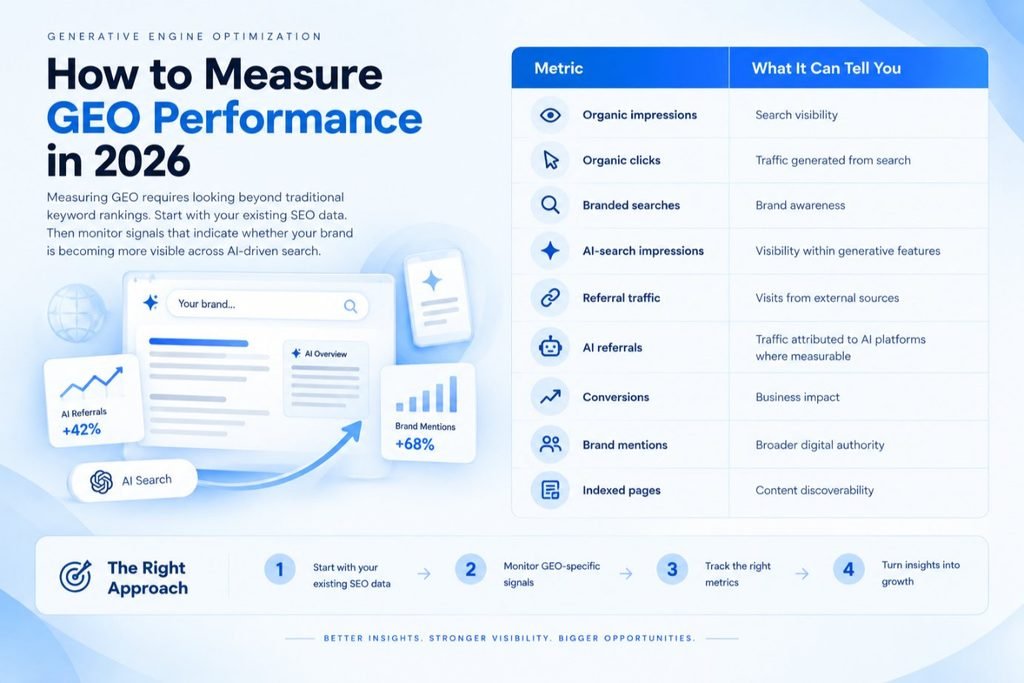
Measuring GEO requires looking beyond traditional keyword rankings.
Start with your existing SEO data.
Then monitor signals that indicate whether your brand is becoming more visible across AI-driven search.
Useful metrics include:
| Metric | What It Can Tell You |
| Organic impressions | Search visibility |
| Organic clicks | Traffic generated from search |
| Branded searches | Brand awareness |
| AI-search impressions | Visibility within generative features |
| Referral traffic | Visits from external sources |
| AI referrals | Traffic attributed to AI platforms where measurable |
| Conversions | Business impact |
| Brand mentions | Broader digital authority |
| Indexed pages | Content discoverability |
Do not judge GEO solely by the number of times an AI system mentions your brand.
Business outcomes matter too.
If visibility produces qualified traffic, leads, enquiries, sales, or stronger brand discovery, those outcomes provide more meaningful evidence of progress.
GEO, SEO, and AI Search: A Long-Term Strategy
Search is becoming increasingly conversational.
People can ask longer questions, refine them through follow-ups, compare several options, and expect direct answers.
That changes how businesses should think about content.
Instead of asking only:
“What keyword should I rank for?”
Ask:
“What questions does my customer ask before choosing a business like mine?”
Then build the information ecosystem that answers those questions.
That means combining:
- Technical SEO
- On-page SEO
- Local SEO
- Content strategy
- AEO
- GEO
- Entity optimization
- Digital PR
- Brand building
- Structured data
- Conversion optimization
For an Italian business, Generative Engine Optimization Italy should therefore be part of a broader digital visibility strategy rather than a standalone tactic.
The brands that invest in useful information, clear positioning, technical accessibility, and genuine authority will have stronger foundations as search continues to evolve.
Why Work With a GEO Specialist?
Implementing GEO effectively requires more than adding the words “AI search” to existing SEO content.
A specialist can evaluate:
- Current organic visibility
- Search intent
- Content architecture
- Technical SEO
- Entity signals
- Brand authority
- Local relevance
- Italian-language content
- Competitor positioning
- Internal linking
- Structured data
- AI-search opportunities
The strategy should then be aligned with your actual business goals.
For a local Italian company, that could mean improving discovery in a specific city.
For an e-commerce business, it could mean creating stronger content around product research and comparisons.
For a B2B company, it could mean building topical authority around complex industry questions.
The approach should be based on the business, audience, market, and search behavior rather than a generic checklist.
Frequently Asked Questions
What is Generative Engine Optimization in Italy?
Generative Engine Optimization Italy refers to optimizing a business’s website, content, entity signals, and broader digital presence for AI-driven search experiences relevant to the Italian market.
Is GEO replacing SEO?
No.
Traditional SEO remains important because search engines still need to discover, crawl, understand, and evaluate webpages.
GEO complements SEO by adding strategies specifically relevant to generative and answer-based search.
Can GEO guarantee that my business will appear in ChatGPT?
No.
No legitimate specialist can guarantee that a particular AI system will cite a specific business for every query.
The goal is to improve discoverability, relevance, authority, and the quality of signals surrounding your brand.
How does ChatGPT Search use websites?
ChatGPT Search can search the web and provide links to relevant sources.
This means businesses should continue investing in accessible, useful, authoritative content that clearly communicates what they offer.
Does Italian-language content matter for GEO?
Yes, when your target audience searches in Italian.
High-quality localized content can communicate your expertise and relevance to Italian users more naturally than direct word-for-word translations.
Does local SEO matter for GEO?
Yes.
Local SEO helps establish information about where a business operates and what it provides.
Clear business information can also help search engines understand local entities and their relationships with locations and services.
How long does GEO take to work?
There is no universal timeline.
Results depend on the website’s existing authority, technical condition, content quality, competition, industry, publishing frequency, and external signals.
GEO should be treated as a long-term visibility strategy rather than a quick ranking trick.
What should an Italian business optimize first?
Start with the fundamentals:
- Technical accessibility
- Search intent
- High-quality Italian content
- Clear service pages
- Local and entity information
- Internal linking
- Author and business credibility
- Relevant external mentions
- Structured data where appropriate
- Measurement and ongoing improvement
Can small Italian businesses use GEO?
Yes.
A small business does not need thousands of pages to build useful AI-search foundations.
It can start by creating genuinely helpful service pages, answering customer questions, establishing consistent business information, and building relevant local authority.
Is Generative Engine Optimization Italy only for companies in Milan or Rome?
No.
The strategy can be applied to businesses throughout Italy.
The exact approach should change according to the company’s location, service area, industry, audience, and search intent.
Build Your AI Search Visibility in Italy
AI-powered search is changing how people discover information and businesses.
But the fundamentals remain familiar: be useful, be technically accessible, demonstrate expertise, build trust, and create information that genuinely helps people.
Generative Engine Optimization Italy brings these principles into the emerging world of generative search.
If your business wants to improve its visibility across Google AI experiences, ChatGPT Search, and other AI-driven discovery channels, now is the time to build the right foundation.
A strong GEO strategy does not chase individual AI answers.
It builds a brand that search engines, AI systems, and customers can understand and trust.
Ready to improve your AI search visibility in Italy? Book a free consultation and build a GEO strategy around your business.
Choose the Best SEO Expert in Italy
Start your growth journey today!